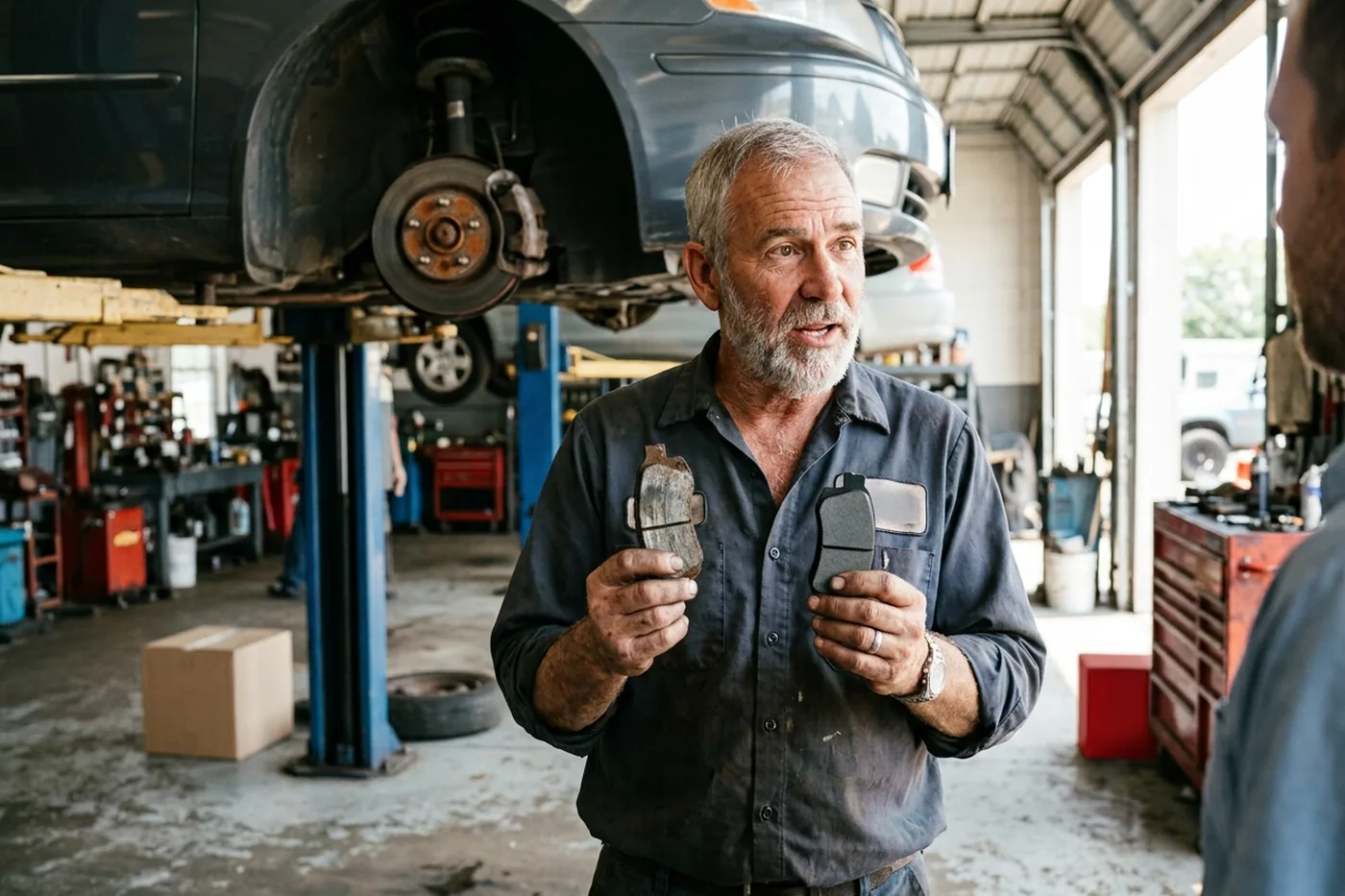
Brake pads wear gradually and predictably, which means the decision to replace them is usually a scheduling question rather than an urgent one. Knowing which signals are which prevents both unnecessary work and the far more expensive kind of delay.
Thickness is the real measurement
New pads typically start around 10 to 12 millimetres of friction material. Replacement is generally recommended around 3 millimetres and becomes necessary below that. Below roughly 2 millimetres you are approaching the backing plate, and contact between backing plate and rotor destroys the rotor, turning a pad replacement into a pad and rotor replacement.
Any shop measuring pads should give you the numbers, in millimetres, per wheel. "Your brakes are low" is not a measurement. Ask for the figures and write them down, because it lets you judge how much life remains and compare against the next inspection.
The noises, in order of seriousness
A high-pitched squeal when braking is usually the wear indicator, a small metal tab designed to contact the rotor and make exactly that noise when material runs low. This is the system working as intended. Book the work within a few weeks.
Squealing only in the morning or after rain is generally surface rust burning off in the first few stops. Normal, and not a fault.
A grinding or metallic scraping under braking means the friction material is gone and metal is contacting metal. This is the one that is urgent, both for stopping distance and because every mile deepens the rotor damage.
What the pedal tells you
| Symptom | Usual cause | Urgency |
|---|---|---|
| Pulsation through the pedal | Rotor thickness variation or warping | Soon, worsens with heat |
| Pedal travels further than usual | Air in the system, worn pads, or a fluid leak | Immediate inspection |
| Pedal sinks slowly while held | Failing master cylinder | Do not drive |
| Vehicle pulls to one side | Sticking caliper or uneven pad wear | Soon |
| Burning smell after a descent | Overheated brakes | Stop and let them cool |
Rotors: resurface or replace
Rotors have a minimum thickness specification stamped on them. A rotor can be machined flat if enough material remains above that figure, but modern rotors are frequently made thin enough that machining is not viable, and the cost of new rotors has fallen to the point where replacement is often similar in price. If a shop proposes machining, ask what thickness the rotors measure and what the minimum is.
Replace or machine in axle pairs, never one side alone, since uneven braking side to side is a handling problem.
What affects how long pads last
Pad life varies enormously, from perhaps 25,000 to well over 70,000 miles, driven mostly by use rather than by product quality. Stop-start city driving wears pads several times faster than highway miles. Towing, hilly terrain and heavy vehicles all shorten life. Front pads wear faster than rear on most vehicles because weight transfers forward under braking.
Regenerative braking on hybrids and electric vehicles reduces pad wear dramatically, sometimes to the point where pads outlast the rotors' corrosion life, since they are used so rarely they never clean the rust off.
Brake system defects are a common subject of safety recalls. Check your vehicle by VIN at NHTSA's recall lookup, where any repair is free regardless of who owns the vehicle.
The one thing not to defer
Brake fluid is hygroscopic, meaning it absorbs moisture from the air over time. Moisture lowers the boiling point, and fluid that boils under heavy braking produces a soft pedal at the worst possible moment. Most manufacturers specify a fluid change every two to three years regardless of mileage. It is inexpensive, it is frequently skipped, and it is the brake service that matters most on a car that does not brake hard often.