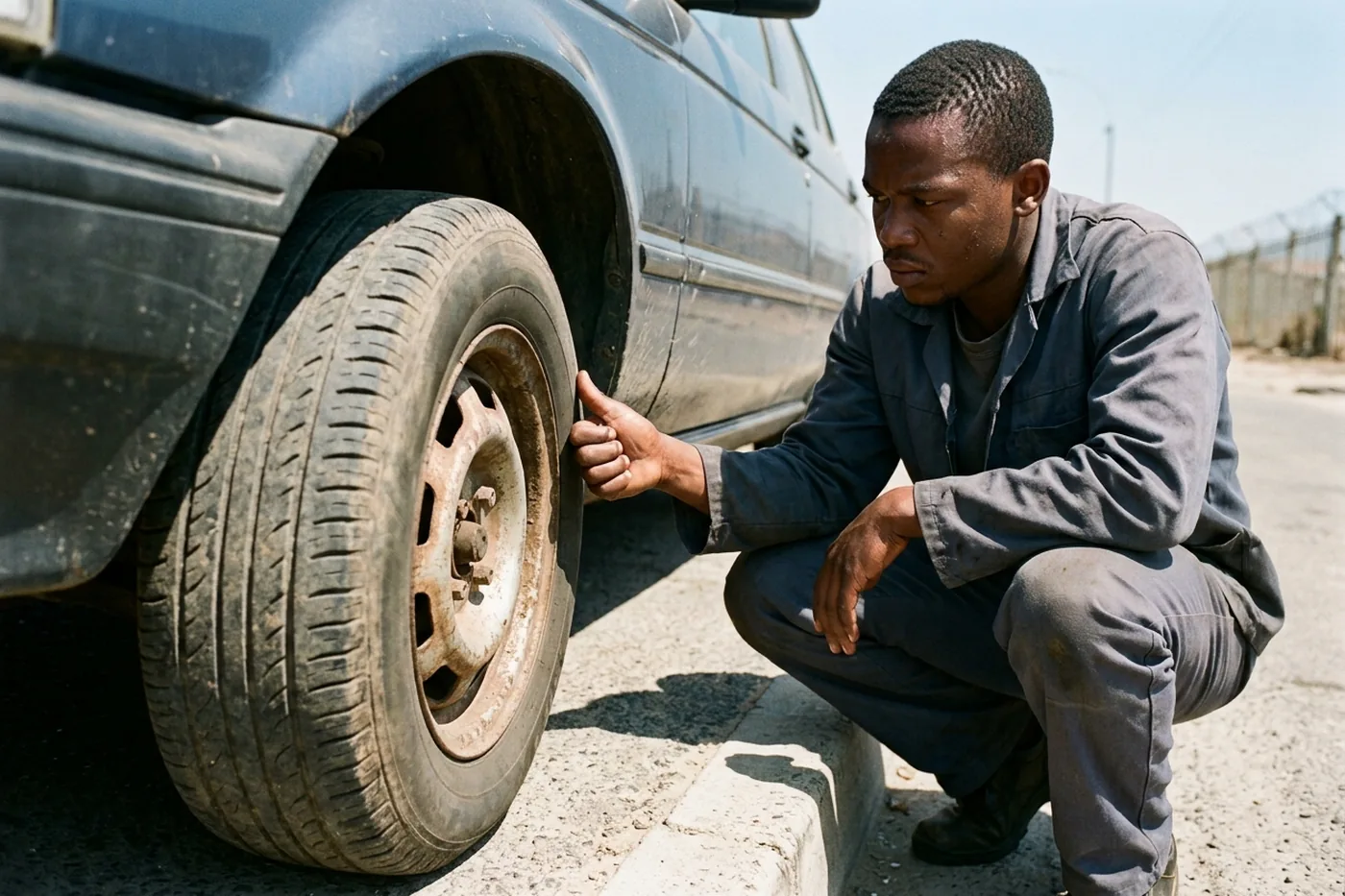
Tires are the only part of the vehicle touching the road, and they wear in patterns that describe problems elsewhere in the car. Reading them is a useful diagnostic skill as well as a safety check.
Tread depth
New passenger tires start with roughly 10/32 to 11/32 of an inch of tread. The legal minimum in most states is 2/32, marked by wear bars molded across the grooves: when the tread is level with those bars, the tire is at the limit.
Legal minimum and sensible minimum are different figures. Wet braking distance degrades sharply below about 4/32, and hydroplaning resistance falls faster still, because the grooves exist to move water out from under the contact patch. If you drive in rain, replacing at 4/32 rather than 2/32 buys a meaningful safety margin.
The penny test approximates this: insert a penny with Lincoln's head down into the groove. Touching the top of his head means roughly 2/32 or less. A quarter tests for about 4/32.
Age matters independently of tread
Rubber degrades over time whether or not the tire is used. Compounds harden, and the structure can develop cracks that are not visible from outside. A tire with plenty of tread can still be unfit if it is old enough, which catches people with low-mileage vehicles, spare tires and trailers.
Every tire carries a DOT code on the sidewall ending in four digits: the week and year of manufacture. 3223 means the 32nd week of 2023. Many manufacturers recommend replacement at six to ten years from that date regardless of tread, and vehicle manufacturers often specify a figure in the owner's manual.
Wear patterns and what causes them
| Pattern | Usual cause |
|---|---|
| Both edges worn, center fine | Chronic underinflation |
| Center worn, edges fine | Chronic overinflation |
| One edge only | Camber or alignment out of specification |
| Feathered, sharp edges across the blocks | Toe misalignment |
| Patchy or cupped scalloping | Worn shocks or struts, or imbalance |
| Flat spot in one place | Locked-wheel braking or long storage |
The useful point is that replacing tires without fixing the cause simply wears the new set the same way. A tire worn on one edge should be a conversation about alignment, not just a sale.
Pressure
Check pressures monthly, cold, before driving. The correct figure is on the placard in the driver's door jamb, not the number on the tire sidewall, which is the tire's maximum rather than the vehicle's specification.
Pressure falls roughly one psi for every ten degree Fahrenheit drop in ambient temperature, which is why tire pressure warnings appear on the first cold morning of the year. Underinflation increases wear, reduces fuel economy and raises heat buildup, which is the mechanism behind most highway blowouts.
How many to replace
Four is ideal. If replacing two, fit the new pair to the rear axle regardless of which wheels drive the car, because the rear losing grip first produces oversteer that is much harder to recover than the understeer of a front-end slide.
All-wheel-drive vehicles are stricter: many manufacturers require all four tires to be within a small tolerance of each other in circumference, because differences make the drivetrain work continuously to reconcile them. On those vehicles, replacing one tire can mean replacing all four, or having the new tire shaved to match.
NHTSA publishes tire safety and maintenance guidance, including how to read sidewall markings, at nhtsa.gov.